Most technology conversations in corporate settings eventually circle back to the same frustration: we have all the tools, all the data, all the systems and yet nothing talks to each other. Decisions are slow. Costs creep. Projects drift. And nobody can quite explain why.
There's an old name for this problem. We just haven't been using it.
•The Tower of Babel, Rebuilt in Every Large Company
In the biblical story, the Tower of Babel collapses not because of incompetence or lack of resources but because the builders suddenly couldn't understand each other. Communication broke down, and with it, the entire project.
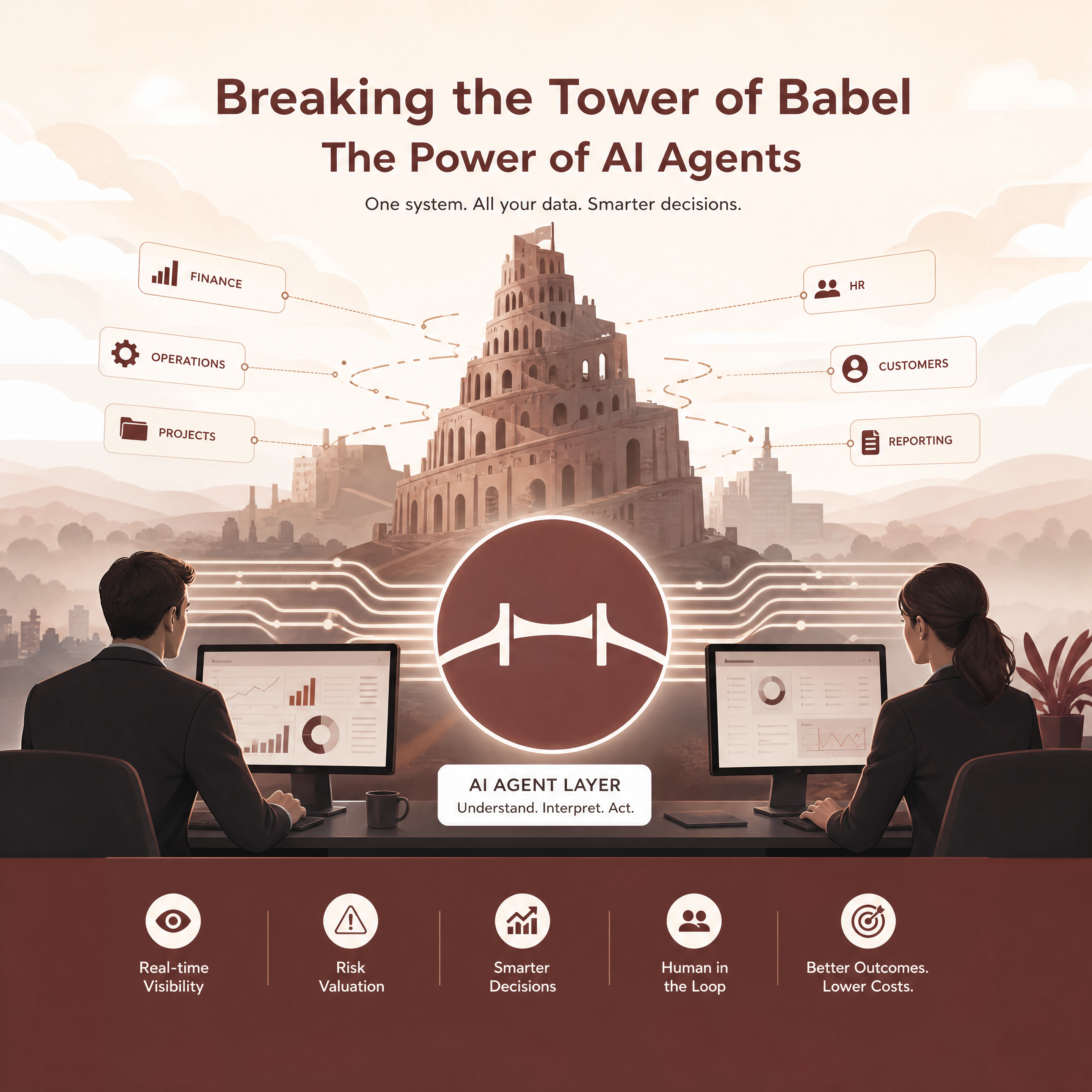
Walk into most medium-to-large companies today and you'll find the same structure, quietly running in the background. Finance uses one system. Operations uses another. Project management runs on a third. HR has its own platform. Customer data lives somewhere else entirely. Each department has developed its own language, its own logic, its own interpretation of what's happening and when those interpretations need to meet, the friction is enormous.
The Babel problem: It's not a technology failure. It's a coordination failure that technology has made worse by multiplying the number of isolated systems a company depends on.
I had the chance to sit down with Onur Uça and Faysal Yörük from Opus Smart Solutions to talk through exactly this. The conversation was one of the most direct and clear-eyed discussions I've had about what AI actually means for how organisations function and what it costs when they get it wrong.
•The Financial Reality of the AI Gap
When systems don't communicate, humans become the connective tissue. Someone manually exports data from one platform and imports it into another. Someone else interprets two conflicting reports and decides which one to trust. A project manager chases five different people for status updates that, in a connected system, would be visible in seconds.
This is the AI gap the distance between what a company's systems could theoretically know and act on, and what they actually surface to the people making decisions. That gap has a direct financial cost: in headcount spent on coordination rather than value creation, in delayed decisions that let problems compound, in project overruns that could have been caught weeks earlier if the right signal had been visible.
For enterprise firms managing multiple workstreams simultaneously that gap isn't theoretical. It shows up in project management timelines, in procurement cycles, in the overhead required just to maintain situational awareness across the business.
•Integrated AI Agents: A Different Kind of Answer
The conversation with Onur and Faysal moved quickly to what a real solution looks like and it's not another tool to add to the stack. That would just be another brick in the Babel tower.
The answer is a layer that sits across all existing systems: an integrated AI agent architecture that doesn't replace the tools a company already uses, but connects them into a coherent, observable whole. One system that reads from all sources, understands context across them, flags anomalies, and surfaces the information that matters to the right person at the right moment.
The key distinction: A well-designed AI agent layer doesn't just report what's happening it interprets what it means. A delay in one workstream gets evaluated against its downstream dependencies, its financial implications, its likely causes. The agent brings forward a risk-weighted view of the organisation's current state, continuously, without anyone having to ask for it.
This is what separates AI agents from AI tools. A tool answers a question you already know to ask. An agent monitors the whole system and tells you which questions you should be asking.
•The Human in the Loop
One point that Onur raised and it's an important one is that none of this is about removing humans from the process. The goal isn't automation for its own sake. It's about getting human attention to land in the right place.
Most of the cognitive load in complex organisations isn't decision-making. It's information processing: gathering, checking, reconciling, formatting, distributing. This is exactly where AI agents should operate. When the agent handles the information layer, the humans in the organisation can focus entirely on judgment, relationships, and decisions that genuinely require them.
Human in the loop isn't a constraint on what AI can do. It's the design principle that makes AI deployable in high-stakes environments where accountability matters. In organisations with international clients and complex reporting requirements, that accountability is non-negotiable.
•Cost Management as an Outcome, Not a Goal
The downstream effect of getting this right is cost management but it's worth being precise about what that means. It doesn't mean cutting headcount. It means redirecting capacity.
When coordination overhead drops, people who were spending half their time reconciling systems and chasing status updates start spending that time on the work that actually moves the business forward. Projects complete closer to schedule because problems are flagged earlier. Financial exposure from undetected risks shrinks. The organisation becomes faster and cheaper to operate not because anyone cut anything, but because the system stopped wasting what it already had.
“The organisations that get this right don't just become more efficient. They become structurally faster than their competition at every decision that matters.
KEKerem Ege PaktenFounder & CEO, KMCP Solutions