Something shifted in the last two years, and most businesses haven't caught up with it yet.
People stopped going to Google for every question. Now they ask ChatGPT. They use Perplexity. They read Google's AI Overviews instead of clicking through to a website. The search journey the path a potential client takes from 'I have a problem' to 'I found the right company' has fundamentally changed.
SEO was built for one version of that journey. GEO is built for the version that's replacing it.
•What's Actually Different
Search Engine Optimisation (SEO) is the practice of making your website rank well on Google. It's been the cornerstone of digital visibility for two decades, and it still matters. That part hasn't changed.
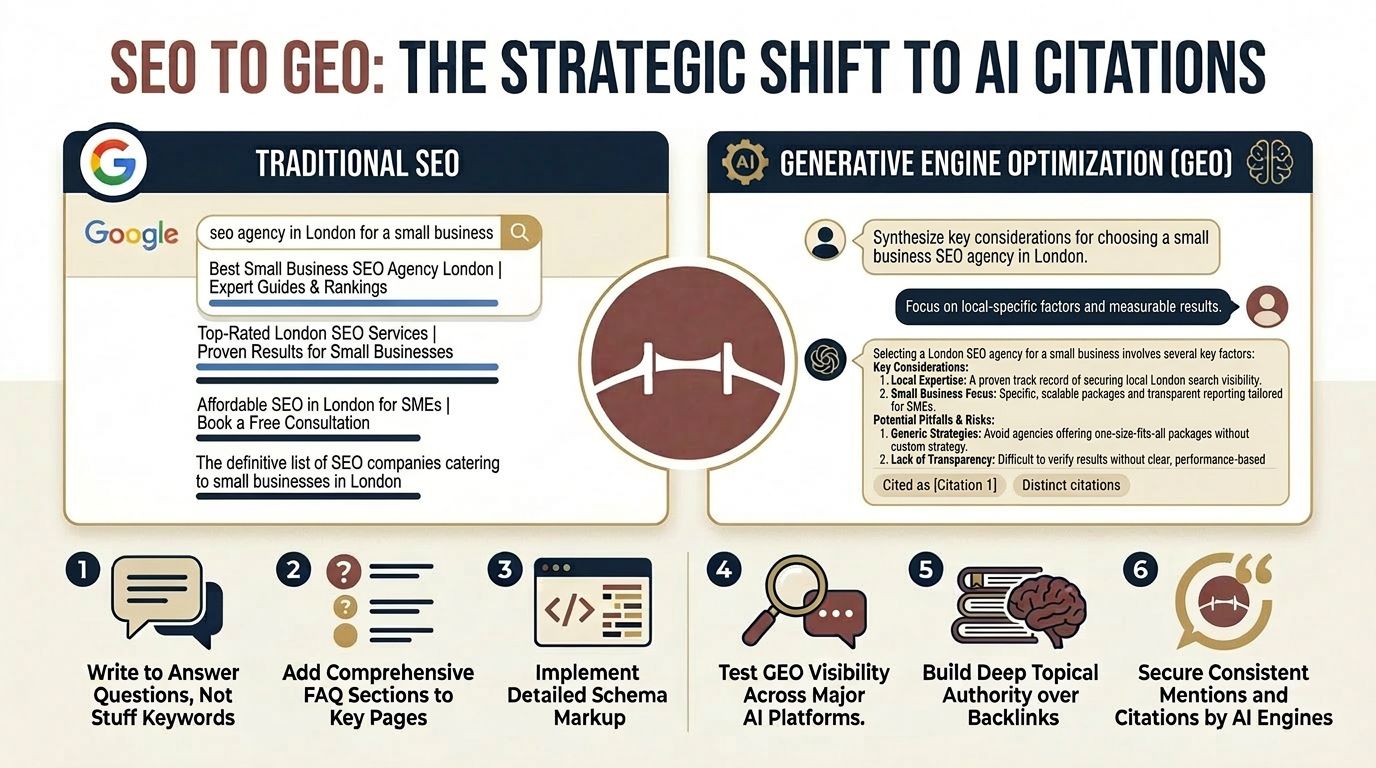
What has changed is the destination. When someone types a question into ChatGPT or Perplexity, they don't get a list of ten blue links and choose which one to click. They get a single synthesised answer and that answer either includes your business or it doesn't. There's no page two. There's no 'just below the fold.' You're either in the answer or you're invisible.
SEO vs GEO: SEO = ranking on Google. GEO = getting cited by AI. The two are related a strong SEO foundation helps GEO but they're not the same. Businesses that treat them as identical are leaving significant visibility on the table.
•Six Things You Can Do Right Now
1. Write like you're answering a question, not stuffing keywords. AI doesn't rank pages it pulls the best answer. If your website reads like a keyword-dense brochure, it won't get cited. If it reads like a clear, helpful answer to a real question, it will.
2. Add FAQ sections to your key pages. Structured question-and-answer content is one of the most reliable GEO signals. Take the five to ten questions your clients ask most often and put them on your site with honest, direct answers.
3. Use schema markup the language AI reads behind your site. Schema markup is structured data embedded in your website's code that tells AI models exactly what your content is about: FAQ schema, LocalBusiness schema, Service schema. These aren't visible to visitors, but they're how AI systems categorise your content with confidence.
4. Test your GEO visibility today. Open ChatGPT or Perplexity and search for what your business does: 'Best [your service] in [your city]'. If your business doesn't appear, that's your baseline. It's not a verdict it's a starting point.
5. Build topical authority, not just backlinks. AI models don't count backlinks they assess depth. If your website covers a subject from multiple angles (service pages, blog posts, guides, case studies, FAQs), AI treats you as a genuinely authoritative source on that topic.
6. Keep your content current. AI models are trained on recent content and tend to favour it. Identifying your ten to fifteen most important pages and maintaining them as genuinely current resources signals to AI systems that your content is alive and trustworthy.
•The Bigger Picture
Search is splitting into two parallel tracks. The traditional track Google, click-through, rankings still carries enormous volume, and ignoring SEO in favour of GEO would be a mistake. But AI search is growing fast, and the trajectory is clear. The businesses that appear on both tracks will have a compounding advantage over those that appear on only one.
The good news is that the foundations overlap. Clear, well-structured, authoritative content serves both SEO and GEO. The businesses that have invested in genuine content quality not keyword manipulation, but actually useful, well-organised information are already better positioned for the AI search era than they realise.
The businesses that haven't are running out of time to catch up before the gap becomes structural.
•Where to Start
If you're not sure where you stand, start with tip number four. Open ChatGPT and search for your own business. Search for the service you provide in your city. Search for the question a new client would ask before they hire someone like you.
“The result will tell you immediately whether you have a GEO problem and how urgent it is. At KMCP Solutions, we help businesses build digital infrastructure that performs on both tracks: technically sound for traditional search, and structured correctly for the AI tools that are reshaping how decisions get made.
KSKMCP Solutions TeamKMCP Solutions