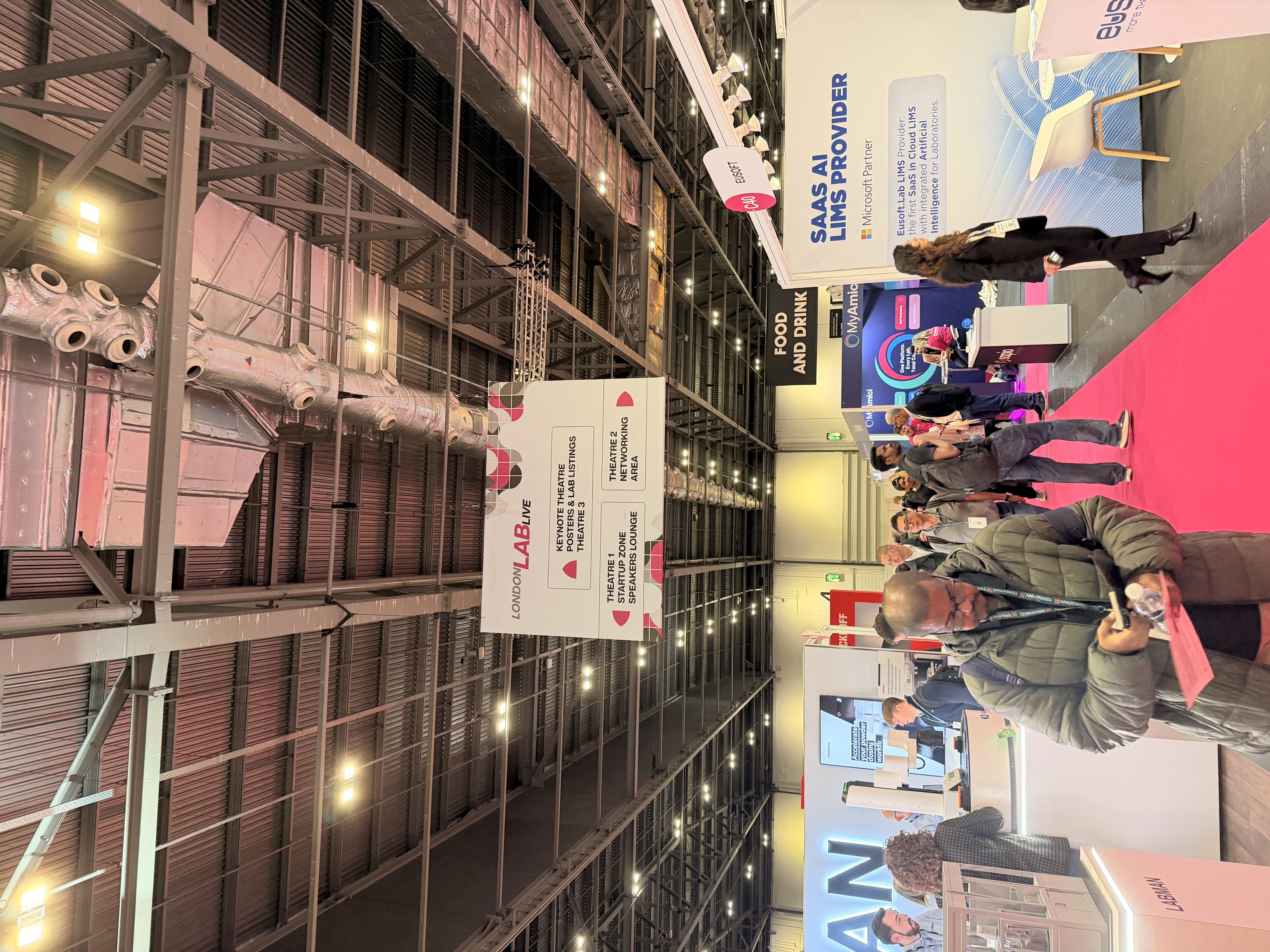
Last week I was at ExCeL London for London Lab Live 2026 two days, over 3,000 attendees, and a programme that made one thing unmistakably clear: the pharmaceutical and life sciences sector isn't wondering whether to adopt AI agents. They've already done it, and they're now teaching each other how to do it better.
That's a different conversation from what most industries are still having.
•The Room
London Lab Live brings together laboratory leaders from pharma, biotech, clinical R&D, food and beverage, and materials science. It's a technically demanding audience people who run experiments at scale, manage vast data environments, and operate under regulatory constraints that most sectors never encounter.
The AI conversation at this event, accordingly, was not about potential. It was about implementation. Specifically: how do you train AI agents to make good decisions inside complex, high-stakes workflows? What does the process look like? And where do humans need to stay in the loop?
Speakers from AstraZeneca, GSK, Novo Nordisk, and Google DeepMind were on stage. The sessions I found most valuable were the ones where practitioners weren't selling a vision they were reporting back from the field.
•Training AI Agents on Real Process Knowledge
One of the standout sessions came from Arnold William, Senior Lab Technician at Beavertown Brewery, who presented "From SOPs to AI Agents: Turning Laboratory Knowledge into Decision Systems." The premise was deceptively simple: take the standard operating procedures, historical lab data, and troubleshooting workflows that already exist inside an organisation the documentation that governs how things actually get done and use them as the training foundation for an AI agent.
The reframe: The challenge isn't generating new knowledge from scratch. It's making existing institutional knowledge accessible and actionable in a way that scales. When a technician who has run a specific process for five years leaves, most of that knowledge leaves with them. An AI agent trained on structured process documentation captures a meaningful portion of it and makes it available to everyone.
The session from Rob Harkness, Senior Director of Automation at GSK, extended this further. His "Lab in an Automated Loop" framework described agents that don't just answer questions but reason across experimental data, orchestrate workflows end-to-end, and operate within a connected data infrastructure. The framing that stayed with me: drug discovery takes 10 to 15 years and more than $2 billion per therapy, with less than 10% clinical success. Agentic AI and intelligent automation aren't optimisation tools in that context they're structural responses to a fundamentally broken cost and timeline model.
•Google DeepMind and the Data Question
Artem Mishchenko from Google DeepMind presented on why experimental data has become the new frontier in AI for materials science specifically, how standardised, well-structured data from automated labs is what enables AI models to move meaningfully between simulation and real-world application.
The point landed well beyond its immediate context. Every industry struggling to get value from AI is, at its core, struggling with the same underlying problem: the data that exists is messy, fragmented, and inconsistently structured. The AI models are often the least of the problem. The data pipeline is where things break down.
The key insight: Pharma's regulatory environment forces data discipline that most industries never develop. SOPs, audit trails, structured formats these aren't optional in a lab context. And that discipline, it turns out, is also what makes AI agents actually work.
•What This Means Outside the Lab
I left ExCeL London thinking about the companies I work with engineering firms, consultancies, real estate groups, e-commerce operations and how much of what was discussed applies directly to them, even though the contexts look nothing alike.
The Tower of Babel problem I've written about before disconnected systems, siloed knowledge, coordination overhead is the same problem pharma was facing five years ago before it started building seriously toward agentic AI. The solutions aren't identical, but the logic is: structure your process knowledge, connect your data environments, design agents that reason across them, and keep humans accountable for decisions that require judgment.
What London Lab Live illustrated clearly is that the sector which has arguably the most to lose from a bad AI deployment where regulatory failure has real human consequences is also the sector moving fastest and most carefully. That combination of urgency and rigour is worth paying attention to, whatever industry you're in.
“The question isn't whether AI agents will reshape how your organisation operates. It's whether you start structuring for it now, or after your sector has had its own version of this conversation.
KEKerem Ege PaktenFounder & CEO, KMCP Solutions